- Was Pearl Harbor really unprovoked?…
- Black and white vs. clarifying gray…
- 🧨 Have you seen page 57 of the Trump Files? The media refuses to talk about it. But it’s already changing the lives of ordinary Americans who’ve acted on it.

Dear Reader,
It is the day that lives in infamy.
I refer of course to Dec. 7, 1941 — 84 years ago yesterday.
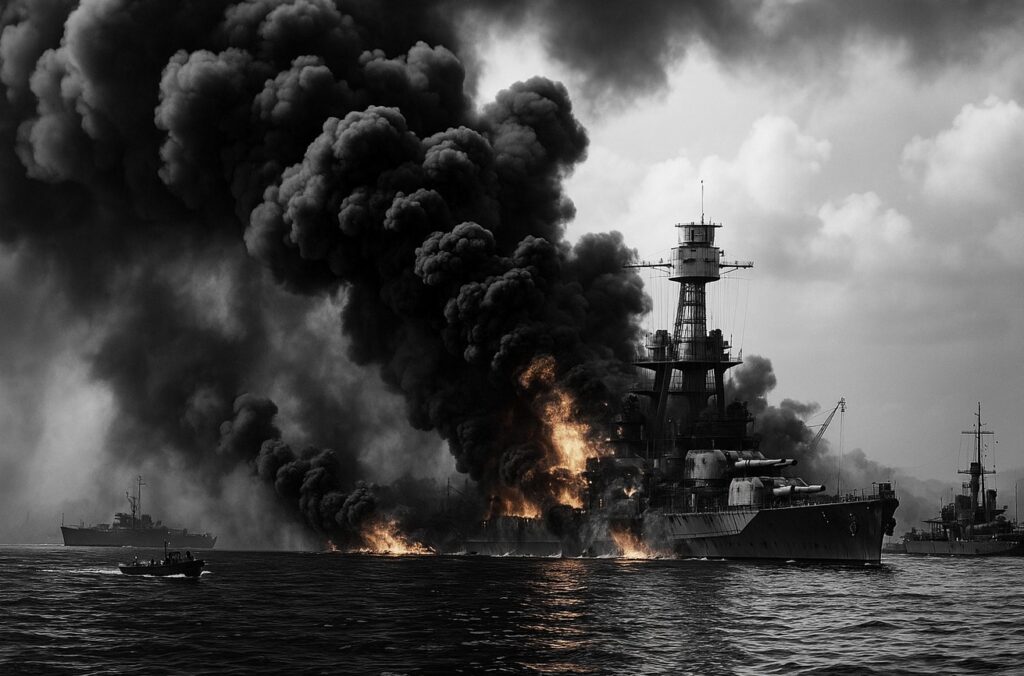
That was the day when Imperial Japanese naval and air forces gave Pearl Harbor a severe working over.
What did most Americans then — and what do most Americans now — have to say about that day?
They were, as they are now, with Roosevelt.
What do I mean?
Roosevelt declared the sucker punch, an “unprovoked and dastardly attack.”
Yet was it a sucker punch, an unprovoked and dastardly attack?
What Most Americans Think
Mr. Robert Higgs of the Independent Institute:
- Ask a typical American how the United States got into World War II, and he will almost certainly tell you that the Japanese attacked Pearl Harbor and the Americans fought back.
- Ask him why the Japanese attacked Pearl Harbor, and he will probably need some time to gather his thoughts. He might say that the Japanese were aggressive militarists who wanted to take over the world, or at least the Asia-Pacific part of it.
- Ask him what the United States did to provoke the Japanese, and he will probably say that the Americans did nothing: We were just minding our own business when the crazy Japanese, completely without justification, mounted a sneak attack on us, catching us totally by surprise in Hawaii on Dec. 7, 1941.
“Dastardly”
I believe the Japanese roughhousing of Pearl Harbor was indeed dastardly.
Here I consult the dictionary. Dastardly:” wicked and cruel,” by definition.
The Japanese armed forces slew in excess of 2,400 Americans that morning. Many were snoozing at the time, harmless as doves.
Japan made wrecks of several warships of the United States… and destroyed nearly 200 American aircraft.
So yes, the assault was dastardly. It was wicked and cruel.
Yet unprovoked? Here I am far less convinced that it was unprovoked.
Maybe not Unprovoked?
In July 1941, the United States government froze all Japanese assets in its possession. In August 1941, the United States government embargoed oil and gasoline exports to Japan.
Mr. Higgs, citing author George Morgenstern:
On July 26, 1941, Roosevelt “froze Japanese assets in the United States, thus bringing commercial relations between the nations to an effective end. One week later Roosevelt embargoed the export of such grades of oil as still were in commercial flow to Japan.”
These were done in response to extensive Japanese buccaneering in Indochina and China.
Meantime, over 80% of Japan’s oil shipped in from the United States.
To choke off Japan’s lifeblood oil was to choke off a man’s oxygenated air. It could not endure without it.
Perhaps the embargoes were justified in full. Imperial Japan was a hungry and expansionist power with eyes glued to the horizon.
It constituted a genuine menace.
Thus the embargoes were justifiable economic measures to box in Japan.
I do not dispute it.
Picking a Fight
Yet United States officials understood their embargoes were backing Japan into a corner that was very, very tight.
They knew they had delivered a severe ultimatum — withdraw from China and Indonesia — else economically starve.
They knew well that Japan would refuse the ultimatum. And that it might take a desperate armed lunge in response.
After all: If you push a man hard and often… if you threaten his means of survival… should you be surprised if he clobbers you in the snout?
Mr. Higgs, once more:
- Roosevelt and his subordinates knew they were putting Japan in an untenable position and that the Japanese government might well try to escape the stranglehold by going to war.
Japan’s war declaration against the United States made very specific mention of the oil sanctions:
- Our adversaries, showing not the least spirit of conciliation… have intensified the economic and political pressure to compel… our Empire to submission. This trend of affairs would, if left unchecked… endanger the very existence of our nation.
- The situation being such as it is, our Empire, for its existence and self-defense, has no other recourse but to appeal to arms and to crush every obstacle in its path.
The United States Pacific Fleet was in its path, alas.
Pearl Harbor Was a “Relief”
United States officials anticipated war. Yet they were adamant that Japan deliver the initial blow.
Here is United States War Secretary Henry Stimson, in a diary entry from Nov. 25, 1941:
- The question was how we should maneuver them [the Japanese] into firing the first shot without allowing too much danger to ourselves.
That is because Mr. Stimson and other senior officials realized a Japanese blow would stir the American public into an extreme state of vengeful incandescence.
They knew it would fill the nation’s recruiting stations with inflamed men, each hot to get his hands on Tojo’s collar.
Just weeks later, here is the same Henry Stimson, reflecting on the Pearl Harbor bloodletting:
- My first feeling was of relief … that a crisis had come in a way which would unite all our people.
Yet here is a question:
Would the American people have reported so eagerly for duty on December 8th… had they known their own government was goading Japan into December 7th?
I am not half so convinced they would have.
(Incidentally: I do not believe Roosevelt was aware of the impending Pearl Harbor raid — yet there are those who do.
I believe he and other senior United States officials expected the hammerblow to fall upon American forces positioned in the Philippines).
Whose Gods Shall We Worship?
Let it go immediately into the record:
I do not bless or condone the Japanese aggressions of Dec. 7, 1941 — whatever its economic justifications.
I am heart and soul against it.
I am out simply to illustrate that truth is often war’s first fatality. And so:
I do not believe that Imperial Japan raided Pearl Harbor in 1941 because Imperial Japan was with the devil.
I believe that Imperial Japan raided Pearl Harbor in 1941 because it advanced Imperial Japan’s interests.
It is truly that simple.
Alas… the world we inhabit is often less a world of clarifying black and white… than of confounding and vexing gray.
The goat’s horns are not necessarily the devil’s horns.
Regards,
Brian Maher
for Freedom Financial News