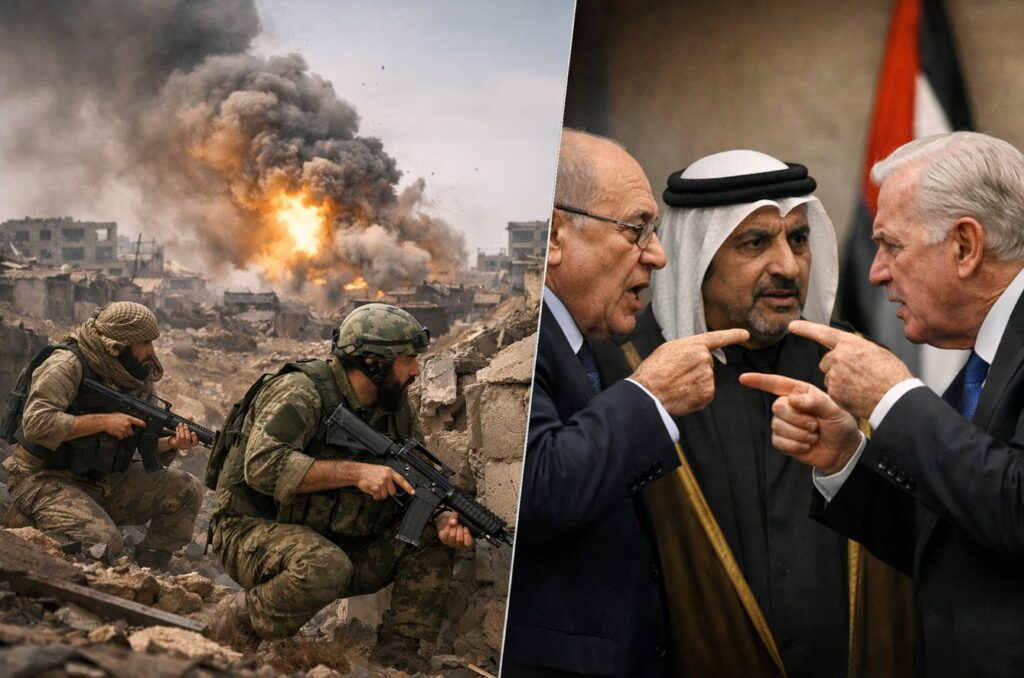
- Well, that didn’t take long…
- Both sides believe they’re winning — and that’s a problem…
- Have you heard of Elon Musk’s $1 quadrillion IPO? If not, click here now because it’s set to be the biggest AI IPO in history… And you could claim a stake today… Before the company goes public… Starting with just $500.

Dear reader,
I argued yesterday that the ceasefire would not cease the fire. Yet I did not expect such an abrupt failure.
Iranian missiles continue hurling towards Kuwait, Bahrain and the United Arab Emirates.
Meantime, Iran’s state media reported yesterday that Tehran is resealing the Hormuz Strait — which Tehran had pledged to unseal under ceasefire terms.
Why? Blame Israel, argues Tehran. It is Israel that is shattering the truce.
Israel continues to bombard Iran’s surrogate, Hezbollah, in southern Lebanon — and heavily.
Tehran argues that the truce requires Israel to stand paws off. And since Israel has not stood paws off, neither will Iran.
Fighting Words
Thundered a certain Mohsen Rezaee, an Iranian parliamentarian:
- In response to the brutal aggression against Lebanon, maritime traffic in the Strait of Hormuz must be halted immediately and a strong, decisive strike must be delivered against the entity.
Adds Iran’s Foreign Minister, ominously and menacingly:
The Iran-U.S. Ceasefire terms are clear and explicit: the U.S. must choose — ceasefire or continued war via Israel. It cannot have both.
The ceasefire’s broker, Pakistani Prime Minister Shehbaz Sharif, appears to be with the Iranians.
This fellow announced that all feuding parties — the United States, Iran and Israel — “have agreed to an immediate ceasefire everywhere, including Lebanon and elsewhere.”
Mr. Netanyahu adopted a rather looser interpretation of the terms.
The two-week truce “does not include Lebanon,” he claimed.
The Trump administration embraces the Israeli’s interpretation.
Vice President Vance labeled the conflicting views a “legitimate misunderstanding”:
- I think this comes from a legitimate misunderstanding. I think the Iranians thought that the ceasefire included Lebanon, and it just didn’t. We never made that promise.
There’s a Lot of Misunderstanding Going on
I begin to conclude that the ceasefire agreement is riddled through with “misunderstandings.”
In particular, that the United States and Iran embrace vastly different understandings of each other’s negotiating position.
President Trump had labeled Iran’s 10-point proposal a “workable basis on which to negotiate.”
And Iran’s president, Masoud Pezeshkian, claims the United States has accepted the “general principles desired by Iran.”
Yet the American president’s press secretary, Ms. Leavitt, claims the president heaved Iran’s 10-point proposal into the hellbox:
- So let me be clear and correct the record. The Iranians originally put forward a 10-point plan that was fundamentally unserious, unacceptable and completely discarded. It was literally thrown in the garbage by President Trump and his negotiating team. Many outlets in this room have falsely reported on that plan as being acceptable to the United States. And that is false.
I hazard there is justice here. I do not believe the president would yield to many of Iran’s proposals.
The American Claim
Meantime, the misunderstandings pile high.
“Iran begged for ceasefire,” declared War Secretary Hegseth.
Yet Iran claims it was their enemies who sank to their knees… and hoisted the truce flag in desperation… that Iran compelled the United States and Israel to accept its “proposed conditions and surrender.”
Truth is widely referred to as the first casualty of war. Here I hazard each side has made a casualty of truth.
The United States believes it has registered a resounding military victory over Iran.
‘We have sunk their navy and wrecked their air force,’ gloats Secretary Hegseth. ‘We have destroyed their offensive capability and their ability to threaten their neighbors,’ he continues.
‘We have all the leverage.’
The Iranian Claim
Iran — meantime — says no, ‘it is we who wield the leverage.’
‘Sure, you and your Israeli crime partners have destroyed a lot of things and killed a lot of people. Congratulations. You’re good at that. But that’s tactics. You Americans focus too narrowly upon tactics. But look at the strategic picture.’
‘Who controls the Strait of Hormuz, one of the world’s most strategic waterways? We do. That means we maintain leverage over the global economy. You just saw what we did to oil prices when we closed the strait. Well, we can do it again. And your mighty navy can’t do anything about it.’
‘That’s called leverage, fella. That’s real power. So don’t stand there crowing about how you defeated us. It’s we who defeated you.’
You may not believe it. The president and the war secretary may not believe it.
Yet the Iranians believe it.
And so I fear renewed military conflict between the United States and Iran is very nearly inevitable.
That is because each side harbors perceptions of its own might. Perceptions, that is, the other side does not share.
And there exists one primary means to reconcile the discrepancy. And that is armed conflict.
War Corrects Misperceptions
Many Germans did not believe they endured a battlefield defeat in World War I. Some 20 years later they believed themselves mightier than subsequent events proved.
After their nation was overrun by Soviets, Americans and British they were compelled to concede defeat.
The power misperception was corrected.
Similarly: Only after twin atomic bombings (and pending invasion by the Soviet Union) did the to-the-bitter-end Japanese sheathe their samurai swords.
The victor and the loser were no longer in dispute.
Why was there a third Punic War between ancient Rome and Carthage?
The answer is because the initial two failed to clarify their conflicting power perceptions.
The third Punic War did clarify their conflicting perceptions of power.… in Rome’s favor… and Rome (mythically) salted Carthage’s ruins.
The central argument I am attempting to establish is that power perception and misperception is behind much armed conflict.
And presently… the United States and Iran share warring perceptions of each other’s power.
Victory at What Price?
Is the United States far mightier than the nation of Iran? By nearly every conceivable metric, the answer is yes.
And the United States believes it can, as the present styles it, return Iran to the “stone ages.”
Indeed, it can.
Yet Iran believes it can outendure the United States in protracted conflict. After all, it has seen the United States slink away from neighboring Iraq and Afghanistan, defeated.
Iran is more formidable than either, they say. Why would war with us be the least bit different?
Meantime, Iran believes it exercises dominion over one of the world’s most crucial waterways… which the United States cannot undo.
Thus a vast perceptual difference separates the two nations.
And I fear only armed conflict can illuminate the truth.
Given adequate time and resolve I am confident the United States would emerge the illuminated victor.
Yet with how much time? And at what price?
Perhaps most importantly:
Are Americans prepared for the sacrifice?
Brian Maher
for Freedom Financial News