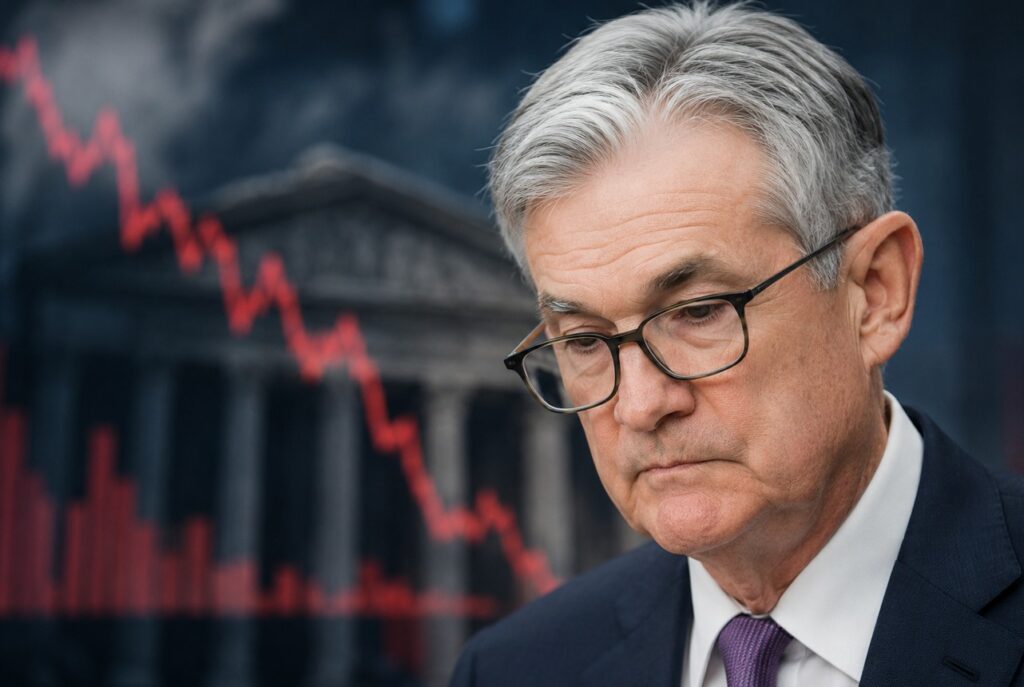
- Will Kevin Warsh stop supporting the stock market?…
- Where you stand depends upon where you sit…
- A Multi-Billionaire and Early Open AI Investor just made a stunning prediction. He just laid out his full research in a free presentation. For the time being, you can watch it here.

Dear Reader,
A headline drifted in over the transom that seized my attention — “Is The Fed Finally Done Rescuing Markets?”
Its author was a market commentator who names himself Quoth the Raven. I have cited him before in these pages.
My excited curiosity compelled me to open the link… and examine its contents.
After all: The Federal Reserve has consecrated itself to the rescue of markets since 1987’s “Black Monday.”
The business accelerated during the “dot.com” tumults… and attained a sort of permanence following the unlit days of the Great Financial Crisis.
Determined interest rate suppression, round upon round of quantitative easing and all manner of intervention defined markets.
And now we have an article suggesting the business may end under new chairman Kevin Warsh.
A New Monetary Sheriff in Town?
Alas, the bulk of the article was barricaded behind a paywall. Yet it gave away a few select tasty morsels.
For example:
- GLJ Research’s Gordon Johnson is one of my favorite analysts on the street to read and gets a rare endorsement from me…
- Johnson came away from this week’s Fed meeting with a conclusion that would have sounded almost absurd just a few months ago: the Fed may finally be breaking with the post-2008 playbook…
- Enter Kevin Warsh’s first press conference as Fed Chair with inflation running completely out of control. My friend GoJo makes the…err…bold claim that the Fed is not tweaking it’s post-2008 playbook…not adjusting it around the margins…breaking with it.
- Johnson’s central argument is that Kevin Warsh’s first meeting as Fed Chair represented a repudiation of the Bernanke-Powell era and a return to a much older conception of central banking…one where the Fed’s primary job is delivering price stability, not reassuring investors, supporting asset prices, or providing a detailed roadmap for every future policy move…
- Warsh stripped forward guidance from the statement, calling it ill-suited to the current environment. He refused to submit his own dot-plot projection. The statement itself was shortened and reduced largely to facts.
Let us contrast, briefly, Mr. Warsh’s seeming approach to his predecessor’s, Mr. Powell’s.
Powell: Low Rates Are a “Fact of Reality”
During his lordship of the Federal Reserve, Mr. Powell informed the Banking Committee of the United States Senate that, “Low rates are not really a choice anymore; they are a fact of reality.”
Thus ended all mummery about “normalization.” Quantitative easing and forward guidance constituted the central armaments in its arsenal.
“We will use those tools,” Mr. Powell pledged, adding “I believe we will use them aggressively.”
Now you have Mr. Warsh swearing off forward guidance. And in previous comments he has denounced quantitative easing — as have I — as “reverse Robin Hood.”
That is, quantitative easing prospers the affluent stock-owning class at the non-affluent, non-stock-owning class’ expense.
Here is how the Australian Financial Review encapsulated Mr. Warsh’s policy approach:
- In November 2010, when the unemployment rate was 9.8 per cent and the personal consumption expenditures deflator – a favoured inflation gauge – just 1.3 per cent, Warsh pushed back strongly against a second round of quantitative easing…
- A decade and a half later, Warsh was still pushing a broadly similar message. He criticised the Fed’s moves during the pandemic, and blamed money-printing and fiscal stimulus for the inflation that ensued… He continues to speak out against the perceived dangers of the Fed’s large balance sheet and even criticised the Fed’s modest rate reductions in 2024.
Yet is Mr. Warsh truly a monetary “hawk?”
Warsh “Goes Both Ways”
Prominent money man Stanley Druckenmiller is a long-standing acquaintance of Mr. Warsh. He has informed us that:
- The branding of Kevin as someone who’s always hawkish is not correct. I’ve seen him go both ways.
And apparently Mr. Warsh has “gone both ways.” Bloomberg:
- Warsh cut against the dovishness of the Bernanke Fed when he was a part of it, but he’s made far more dovish noises recently, and wouldn’t have been given the job if he hadn’t.
Let us then return to the question, “Is The Fed Finally Done Rescuing Markets?”
My answer is no. The stock market simply bulks too large in the overall economic consideration.
The total value of the United States stock market comes in at some $67 trillion — over twice the total value of United States gross domestic product.
No contemporary Federal Reserve chairman can sit idly upon his hands should the stock market take a significant stagger.
The pressure that would come bearing down upon his fairly slender shoulders would be vast.
Too Much Pressure to Resist
From his Wall Street companions, from the financial media, from within the Federal Reserve itself, it would prove nearly impossible to resist.
The president who appointed him would exert no small amount of that pressure.
If the president labeled Mr. Powell “Too Late Powell,” Mr. Warsh would be “Washout Warsh,” “Do Nothing Warsh” or some such.
Within short order Mr. Warsh would be axing interest rates and initiating fresh waves of quantitative easing — depend on it.
Do not forget that the “Maestro” — Alan Greenspan — once advocated zealously for gold.
That zeal went leaking out of him once he assumed the title of Federal Reserve chairman.
“Where you stand depends upon where you sit,” runs an old saw coined by a fellow named Rufus Miles.
Mr. Warsh now sits in the chair assigned the Federal Reserve director.
And during the next stock market mayhem… I hazard he will stand accordingly.
Regards,
Brian Maher
for Freedom Financial News