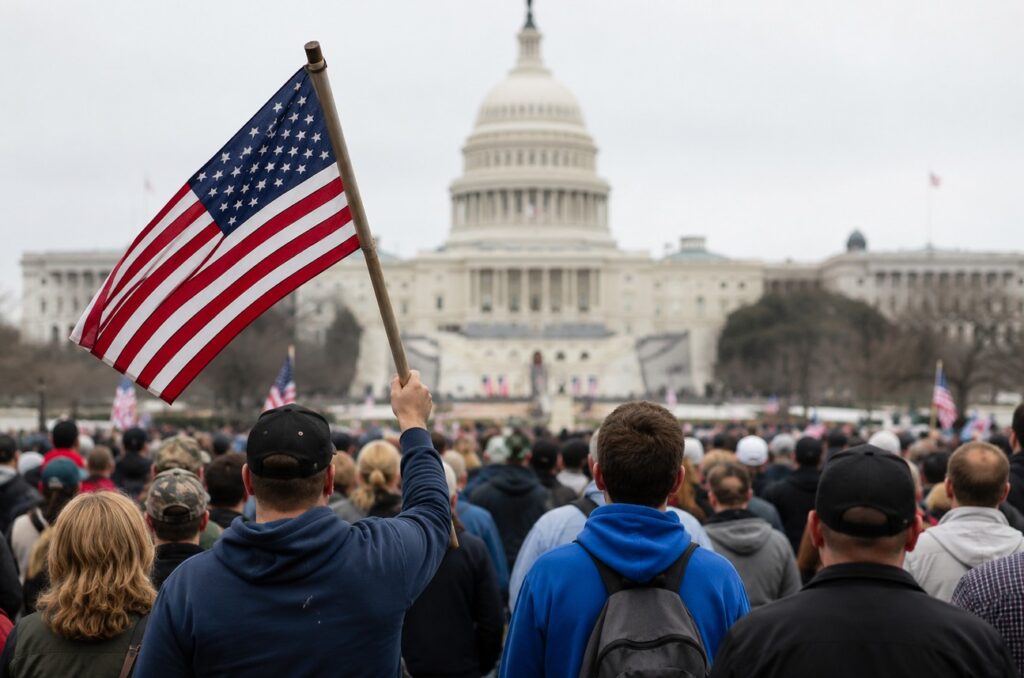
- The American Revolution: “a revolution not made but prevented”…
- The bloody legacy of the French Revolution…
- A Multi-Billionaire and Early Open AI Investor just made a stunning prediction. He just laid out his full research in a free presentation. For the time being, you can watch it here.

Dear Reader,
As the nation prepares to toast its 1776 hatching, let us recall another political revolution that transpired 13 years after… in 1789.
I refer of course to the French Revolution.
Today we contrast the French Revolution with the American Revolution.
Each revolution undid a king — George III in the American example — and Louis XIV in the French example.
Yet while both are labeled revolutions, their purposes were as night is to day.
The Difference
The French revolutionists were out to end the Ancient Regime that sat upon them and burdened them.
That was the old throne and altar social and political system of the Bourbon kings.
The American revolutionists, meantime, were out to reclaim the ancient rights of Englishmen.
It was these rights that George III was invading and molesting… as the American revolutionists saw it.
If you read yesterday’s issue you may have concluded that old George III was quite benign so far as kings go. Yet I let it pass.
The central point is that the American revolutionists were not out for revolution. They were out instead for a sort of reset, as a man resets an erring grandfather clock, or a wayward thermostat.
They did not seek change, that is — but to remain largely the same.
Did they qualify then as revolutionaries?
Enlightenment statesman Edmund Burke labeled England’s Glorious Revolution of 1688-89 “a revolution not made but prevented.”
The same may be said — the same has been said — of the American Revolution.
It was in many respects a revolution not made but a revolution prevented.
You Need Form in Order to Reform
The American revolutionists pursued reform, it is true. Yet reform has no existence without preexisting form.
That is, the form is first. It exists in its three dimensions. You may take its measurements with a ruler. It manifests bulk… and solidity.
Reform chisels the existing form, sands it, paints it, renews it.
Critically, reform does not wreck the existing form.
The Americans had their preexisting form: their British cultural and political heritage.
They clung to the Magna Carta and the ancient rights of Englishmen. They modified, updated and molded the existing form into a new American shape.
That is, they kept the old and good. They cut away the old and diseased.
They reformed.
The French Revolution
Yet the French revolutionists were not out for reform. They were out for blood. Thus they proceeded against the existing form with axes, hacksaws, sledgehammers… and guillotines.
They razed all prior social, cultural, religious and political forms. All structures came down, all bridges to the past.
Nothing remained to reform.
The revolutionists threw aside their “political servitude,” argued Burke — but at the price of their souls.
That is because they threw aside the “yoke of laws and morals” that had bound them to Christian virtue.
They deformed society… rather than reforming society.
From one summary of Mr. Burke’s 1790 Reflections on the Revolution in France:
- The French Revolution… was tending towards anarchy rather than reformation. Burke valued tradition and the structures that had built up over time rather than the shattering of state, culture and religion that had taken place in France.
These French revolutionists had no past, as stated. They had only a future. Do I misstate or stretch the facts?
I do not. I speak by the literal book.
Redrawing Time
In 1792, French revolutionists emptied the existing calendar into the hellbox… and tacked up a new calendar commencing at “Year One.”
All twelve months of the calendar were rechristened, primarily after the rhythms of nature.
The months themselves were broken into three weeks, each consisting of ten days.
Each day — in turn — was reduced to ten hours under a decimal system. One new hour counted 144 miniatures or 2.4 times the old hour.
Churches, meatime, were reconfigured as “temples of reason.”
Libertarian writer, Mr. Lew Rockwell:
- Streets named after saints were given new names, and statues of saints were actually guillotined… The calendar itself, rich with religious feasts, was replaced by a more “rational” calendar with 30 days per month, divided into three ten-day weeks, thereby doing away with Sunday.
- The remaining five days of the year were devoted to secular observances: celebrations of labor, opinion, genius, virtue, and rewards… People were sentenced to death for owning a Rosary, giving shelter to a priest, or indeed refusing to abjure the priesthood.
Now you have the flavor of it. Imagine it — a lunatic nation dynamiting its foundation pillars — and beginning anew at Year One.
How does a man know his birthday… or when to purchase his wife an anniversary gift?
The Democracy of the Dead
The revolutionists, argued Burke, lowered their axes upon what Mr. Lincoln later labeled the “mystic chords of memory.”
These are the chords of memory that link past to present, past and present to future. In brief, that unite a nation across time.
In this democracy of the dead, the dead are granted a vote.
Yay or nay… they have a say in a nation’s doings.
In Burke’s telling:
- As the ends of such a partnership cannot be obtained in many generations, it becomes a partnership not only between those who are living, but between those who are living, those who are dead, and those who are to be born.
The French revolutionaries stripped the dead of their vote. They replaced it with the tyranny of the living.
And future generations would never learn the ancient wisdom.
An Enduring Disaster
The French revolutionists may have struck the old shackles from their wrists. Yet they merely exchanged old shackles for new shackles.
Their ghastly legacy was the slaughter of civilization. Their ghastly legacy was rivers, lakes, seas and oceans of blood.
A man on a pale horse soon debuted upon the scene… and continental war ultimately.
Two centuries of ideological lunacy followed in train.
Messieurs Lenin, Mao, Pot, Castro and other 20th-century devils took their examples from the French revolutionists and their great bloodlettings.
In stark and dramatic contrast stands the American Revolution.
Thus I declare — wholeheartedly — for the American Revolution.
It was the revolution not made… but prevented.
Regards,
Brian Maher
for Freedom Financial News