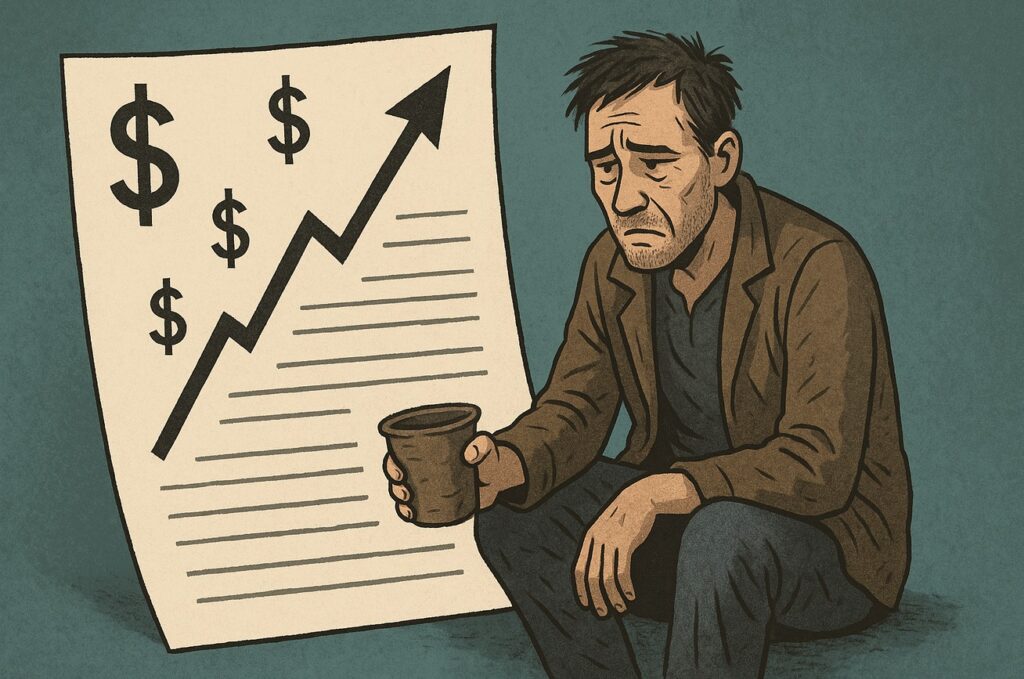
- Delinquencies are rising among record household debt…
- “Doom spending” is tragic…
- CNBC called this new Elon Musk opportunity “the big market event of 2026.” Elon Musk is predicting this investment could jump 1,000x higher from here.

Dear reader,
Reports Insurance Newsnet, with a quiver in its voice:
- [Last week], the Federal Reserve Bank of New York (FRBNY) published new data showing that the share of Americans behind on a range of household consumer debts reached all-time highs in the first quarter of 2026.
- As the nation hurdles toward an historical record of $19 trillion in total household debt, Americans saw the highest rates of auto loan delinquency that FRBNY has ever recorded, rates of credit card delinquency near those last seen at the height of the 2008 financial crisis, and student loan delinquency at its worst since before the COVID-era payment pause.
More:
- According to the FRBNY, Americans have taken on an additional $18 billion in household debt since the final quarter of 2025.., bringing total household debt to an all-time high of $18.8 trillion…
- Credit card delinquency rates are now the highest they have been in 16 years (13.1 percent). Overall student loan delinquency rates soared to 10.3 percent, the highest recorded since 2020…
- In fact, delinquency rates have increased for all credit types tracked by the FRBNY since the final quarter of 2025.
A Two-Tiered Society
Yet we are told the American consumer is flush. She continues to reach into her purse for various extravagances.
I hazard the tip-top consumer who has fattened on stocks and real estate appreciation are indeed flush — on paper at least.
Yet the average American consumer? A far more difficult calculus applies.
Meantime, are you seeking to purchase a house? You may dislike the financing.
The 30-year Treasury bond presently yields 5.19% — its highest since 2007.
And the average rate on a 30-year fixed mortgage presently rises to 6.68%.
How long before the average rate scales 7%… or even 8%?
If inflation remains unbottled, I hazard it will not be long at all.
The Kobeissi Letter, in summary of the American consumer’s tight fix:
- American consumers are now facing 7%+ mortgage rates, 4%+ inflation, and a 30% loss in the purchasing power of the US Dollar since 2020… Since the start of the Iran War… gas prices are up +52%.
Is it a wonder — then — that delinquencies are on the jump?
I do not believe it is a wonder.
Doom Spending
I have previously referred to “doom spending.” Doom spending:
- When a person mindlessly shops to self-soothe because they feel pessimistic about the economy and their future.
I hazard we are witnessing a form of doom spending… for many Americans at least.
As I have explained before: Debt — in itself — is not necessarily the scarlet sin of profligacy and wastreldom.
A man may heave himself into debt to expand his business in anticipation of fat times ahead.
His debt may thus be considered productive debt.
Yet doom spending is not productive. It is not merely unproductive, it is anti-productive.
It represents life upon the hamster wheel, of running fast but standing still. It lives for today. The morrow is beyond its care.
Doom spending may keep the show running — temporarily at least. Yet it meanders down the garden path to economic immiseration and perdition.
It is the economics of the shiftless. It is the economics of the ostrich, with his head submerged beneath the sand in escape from hard reality.
Thus doom spending is “unhealthy and fatalistic,” argues a certain Ylva Baeckstrom, finance lecturer at King’s Business School.
I must conclude she is correct.
The Young Are Uniquely Prone to Doom Spending
America’s youthful are particularly prone to doom spending.
For the first occasion in generations, youthful Americans believe they will fare poorer than their parents.
They believe they are being served the uncooked meal — the raw deal.
Median earnings for those 25–34 have lagged older Americans since the Great Recession.
Compare them to the youths of 1987. Today’s youthful pay triple the rent of 1987’s youthful.
Today’s house is five times costlier than 1987’s.
In 1989, the youthful cohort stored in 20% of all United States wealth.
Today the youthful cohort boasts under 10% of all United States wealth.
The Real Villain
As I have done on several occasions, it is time to once again identify the central villain of our woeful intergenerational tale.
That villain is of course the Federal Reserve Bank of the United States.
Following the vast tumults of 2008 the Federal Reserve nailed interest rates to the floorboards, commenced multiple rounds of quantitative easing and made itself a general economic menace.
This it did to engorge asset prices — of stocks and houses in particular.
Who were the prime beneficiaries of this Federal Reserve welfare?
The answer is existing homeowners and those who could afford to throw money at stocks.
These were of course Americans of advanced vintage. The youthful were heavily excluded from the calculus.
Good for Me, Not for Thee
It is fantastic for the seasoned American whose house that was worth $300,000 10 years back is now worth $800,000.
Yet what of the underripe American who wishes to purchase that home when it falls upon the market? He cannot do it. He is frozen out.
He may be able to collar the resources for the $300,000 purchase — but not the $800,000 purchase.
And so he wallows in his high-rent apartment and stews in his boiling juices, frustrated.
Is it a wonder that he abandons hope in his future and takes to juiceless doom spending?
Again, it is no wonder whatsoever. The wealth effect has bypassed him.
And as I have concluded previously:
The financial and fiscal authorities have dealt this fellow a very poor hand of playing cards.
Alas, many like him are folding their bum hands… and walking away from the American dream.
Regards,
Brian Maher
for Freedom Financial News