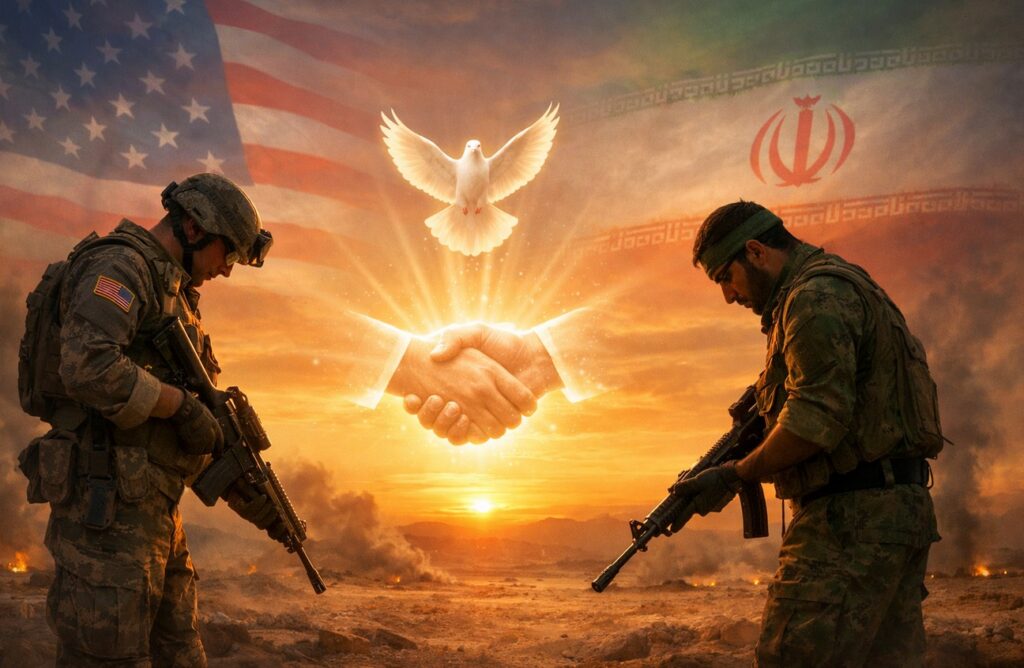
- The U.S. and Iran agree to a ceasefire…
- Why you shouldn’t celebrate just yet…
- Have you heard of Elon Musk’s $1 quadrillion IPO? If not, click here now because it’s set to be the biggest AI IPO in history… And you could claim a stake today… Before the company goes public… Starting with just $500.

Dear reader,
A civilization — Iranian civilization — did not die last evening.
The lenient American president has withdrawn the firing squad, for 14 days at least.
Under two hours before the lethal 8 p.m. deadline… news of a ceasefire went across the wires.
Announced the president, in chest-thumping triumph:
- I agree to suspend the bombing and attack of Iran for a period of two weeks. This will be a double sided CEASEFIRE! The reason for doing so is that we have already met and exceeded all Military objectives, and are very far along with a definitive Agreement concerning Longterm PEACE with Iran, and PEACE in the Middle East.
Thus death takes its holiday. And so there is greater joy in heaven this day.
The Markets Were Thrilled — But Prematurely?
How did the markets absorb the news? The answer is precisely how you would expect them to — in very easy stride.
Dow Jones futures leapt 967 jubilant points. Oil futures plunged a relieved 6%.
For the next two weeks the feuding parties will consecrate their efforts to attaining a permanent resolution of the conflict.
Vice President Vance is expected to front the American delegation.
Yet here is a question: What if the feuding parties cannot sink their differences… and shake upon a permanent resolution?
Mr. Jay Woods, chief market strategist for Freedom Capital Markets:
- It wasn’t much of a surprise that there was an announced reprieve in the Iranian conflict. The market has gotten much better at “sniffing out” Trump’s next move.
- The concern now is if this all too familiar ‘two-week’ timeframe is going to lead to a resolution.
Iran’s 10 Demands
The president declared last evening that, “We received a 10 point proposal from Iran, and believe it is a workable basis on which to negotiate.”
Yet is Iran’s 10-point proposal a truly workable basis on which to negotiate?
Let us examine the 10 points in question:
#1: Non-aggression pact between the United States and Iran…
#2: Continuation of Iran’s control over the Strait of Hormuz…
#3: Recognition of Iran’s nuclear enrichment rights…
#4: Lifting of all primary US sanctions…
#5: Lifting of all secondary sanctions affecting third-party countries…
#6: Termination of all UN Security Council resolutions against Iran…
#7: Termination of all International Atomic Energy Agency (IAEA) Board resolutions…
#8: Payment of compensation to Iran for damages…
#9: Withdrawal of United States combat forces from the region…
#10: Cessation of war across all fronts, including conflicts involving Iran-backed groups such as Hezbollah in Lebanon.
Could Trump Agree to This?
To how many of these demands will President Trump nod his head in assent?
Will he recognize Iranian dominion over the Hormuz Strait — especially if Iran insists that transit fees be paid in Chinese yuan?
Will he agree to sign reparation checks for the damage he has inflicted? Will he withdraw United States combat forces from the region?
I am far from convinced that he will concede any of these cardinal points.
They more resemble Iranian victory points.
Perhaps he may budge and yield on other points. Yet I do not believe he will budge and yield on Iran’s central demands.
And if he does concede them?
It would indicate the president’s keen, keen desperation to wriggle out of the fine fix into which he has wedged himself.
It would indicate his precise knowledge of the spiraling oil price — and the subsequent gasoline price — in an election year.
Unintended Consequences
I hazard the president would dismiss Iran’s victories as mere trivialities that are nothing against the massive military victory of the United States.
Yet how many would believe it?
Under the headline, “The War Is Turning Iran Into a Major World Power,” The New York Times informs us that:
- In recent years, the conventional geopolitical wisdom has been that the world order was moving toward three centers of power: the United States, China and Russia. That view assumed that power derived primarily from economic scale and military capability.
- That assumption no longer holds.
- A fourth center of global power is quickly emerging — Iran — that does not rival those three nations economically or militarily. Instead, its newfound power derives from its control over the most important energy choke point in the global economy, the Strait of Hormuz.
Is this the outcome President Trump intended?
Who’s Willing to Restart Hostilities?
Yet let us assume, for the moment, that peace negotiations fail. That the white doves of peace remain caged in their pens.
Do the United States and Israel resume their aerial onslaughts against Iran?
Does Iran… in turn… again lower the gate across the Hormuz Strait… and lob destructive missiles throughout the Middle East?
I imagine the answers are yes.
Yet whichever side delivers the resumptive blow will don the figurative black hat.
Should it be Iran?
The Islamic Republic will lose much of the world’s sympathy it had previously enjoyed. David stood tall against Goliath — and the world leans in the underdog’s attention.
I hazard that even Iran’s most sympathetic allies, Russia and China, would raise a rumpus.
The U.S. Risk
And should the United States fire first?
The objections leveled against the initial conflict would double, triple, quadruple.
Meantime, gasoline prices would resume their fearsome arc. Global recession would once again appear in prospect.
Domestically, the American people — already irresolute in their support of the conflict — would likely stomp their feet in outraged protest.
The president fears those same feet would march off to the polling station in November… in support of Democrats.
Let me now introduce to the equation a confounding variable. That confounding variable is Israel.
Could Israel Sabotage the Ceasefire?
I do not believe any outcome less than Iranian regime change would gratify Mr. Netanyahu.
I believe he considers a negotiated settlement inadequate. He would like the United States to “finish the job.”
Might he attempt to sabotage the ceasefire?
Might he soon claim, for example, that dastardly Iran has lobbed missiles into Israel in violation of the agreement… and that Israel was subsequently compelled to lob missiles into Iran… in the hopes that the ceasefire would collapse… and reel the United States back in?
I do not know the answer. I merely introduce the possibility.
That is because I am by nature a distrusting and cynical fellow.
I run to suspicious settings.
Thus I am simply not convinced that the ceasefire will hold.
I pray that I am mistaken. Yet I fear that I am not.
Brian Maher
for Freedom Financial News